Hello, I'm Jeremy Dinh
Quantitative by default | Construction cost estimation, CPM schedule engineering, and AI-orchestrated multidisciplinary analysis | Calgary, Alberta
The whole practice, one map
Loading the 3D world...
Drive the truck
to move
Drive the truck
Drag the circle pad to drive
Drive up to a ◆ marker, then tap INTERACT
Experience
Intermediate Estimator — Ledcor, Calgary (May 2023 — Present)
Estimates across all scopes and disciplines, under every delivery method: Lump Sum, CM @ Risk, DBFM. Preconstruction support and value engineering, structural concrete quantification from 3D models, and advanced data analytics: automation, Bluebeam/Excel, and cost, schedule, and risk prediction.
Project Coordinator — Ledcor (Sep 2022 — May 2023)
Coordinating four LEED Silver warehouse and industrial condominium projects.
Builder — Construction AI program
Designed and built the pipeline above: discipline profiles, stratified evidence retrieval, accuracy scored blind against published project outcomes, and the schedule and cost generation workflows.
Selected projects: estimating
Estimating and coordination work, grouped by sector.
Selected projects: coordination (2022–23)
Credentials
McGill University — MMA
Master of Management in Analytics, in progress. Decision analytics, mathematical optimization, machine learning.
SAIT — BSc Construction Project Management
Graduated 2025. Estimating, scheduling, and project delivery derived from first principles.
Construction AI: one system, every discipline
One deterministic front door, one integrated toolkit. Every query traverses the identical gauntlet: evidence stratification before inference, discipline specialists executed in parallel, contractual instruments locked before pricing, and multi-gate audit verification before release. The production stack:
Intake classification accuracy: 85.7% cost class · 81.3% schedule type, adjudicated behind a 0.90 confidence gate. Sub-gate classifications devolve to a deterministic router, with the divergence flagged, never suppressed. The layer is fail-open: model unavailability degrades the pipeline to its deterministic baseline, unchanged.
The swarm at work: a real case
Case study: the Calgary Cancer Centre (Arthur J.E. Child Comprehensive Cancer Centre): 127,000 m², 13 floors, 160 beds, 12 radiation vaults, on the Foothills campus. A public project (built by PCL, opened 2024), re-executed through the pipeline on public facts only: the coordination demonstrated, not asserted.
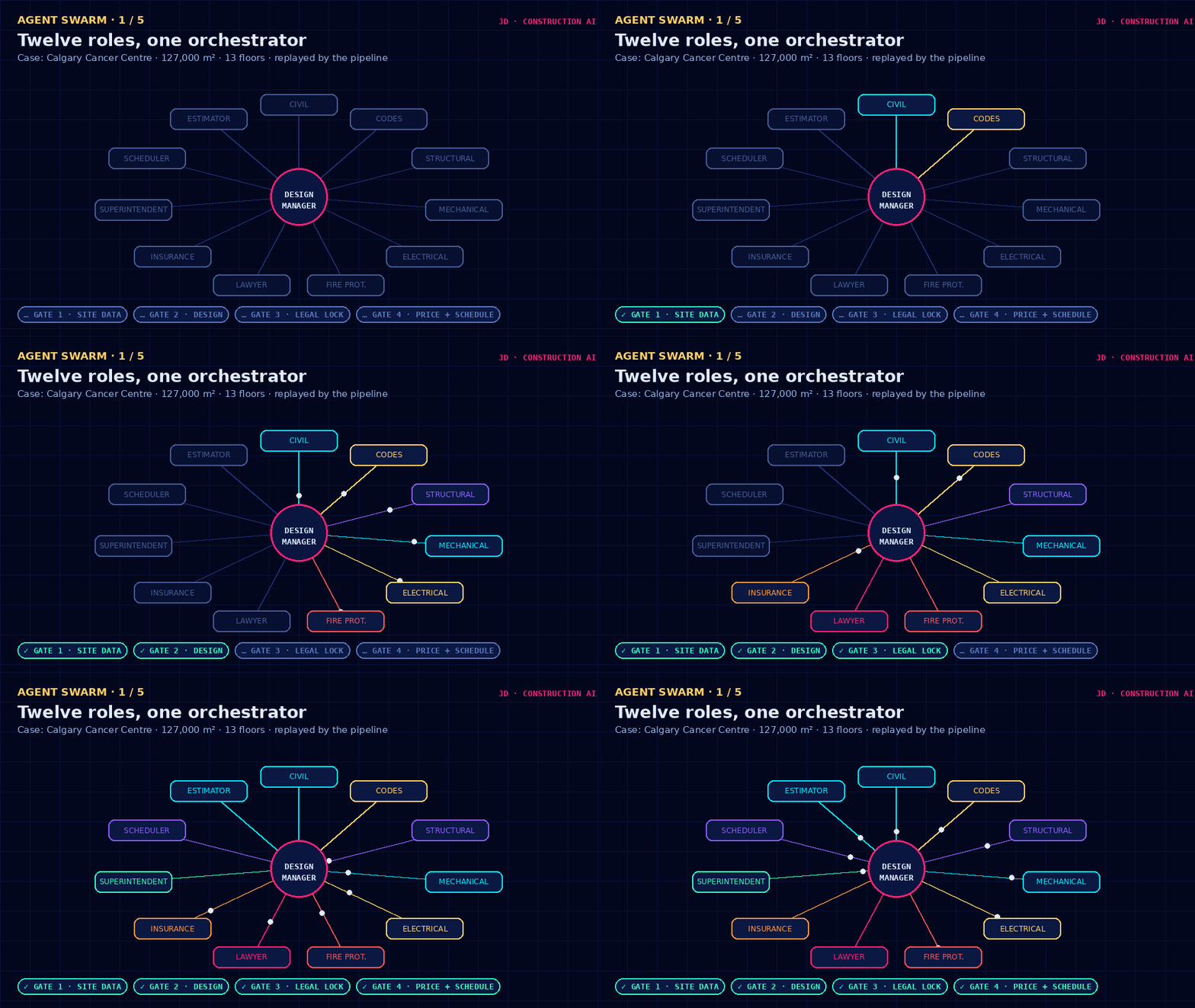
1 · The swarm assembles
The Design Manager dispatches 11 discipline agents in phase-gated waves: site intelligence, design development, contractual lock, then pricing and schedule synthesis.
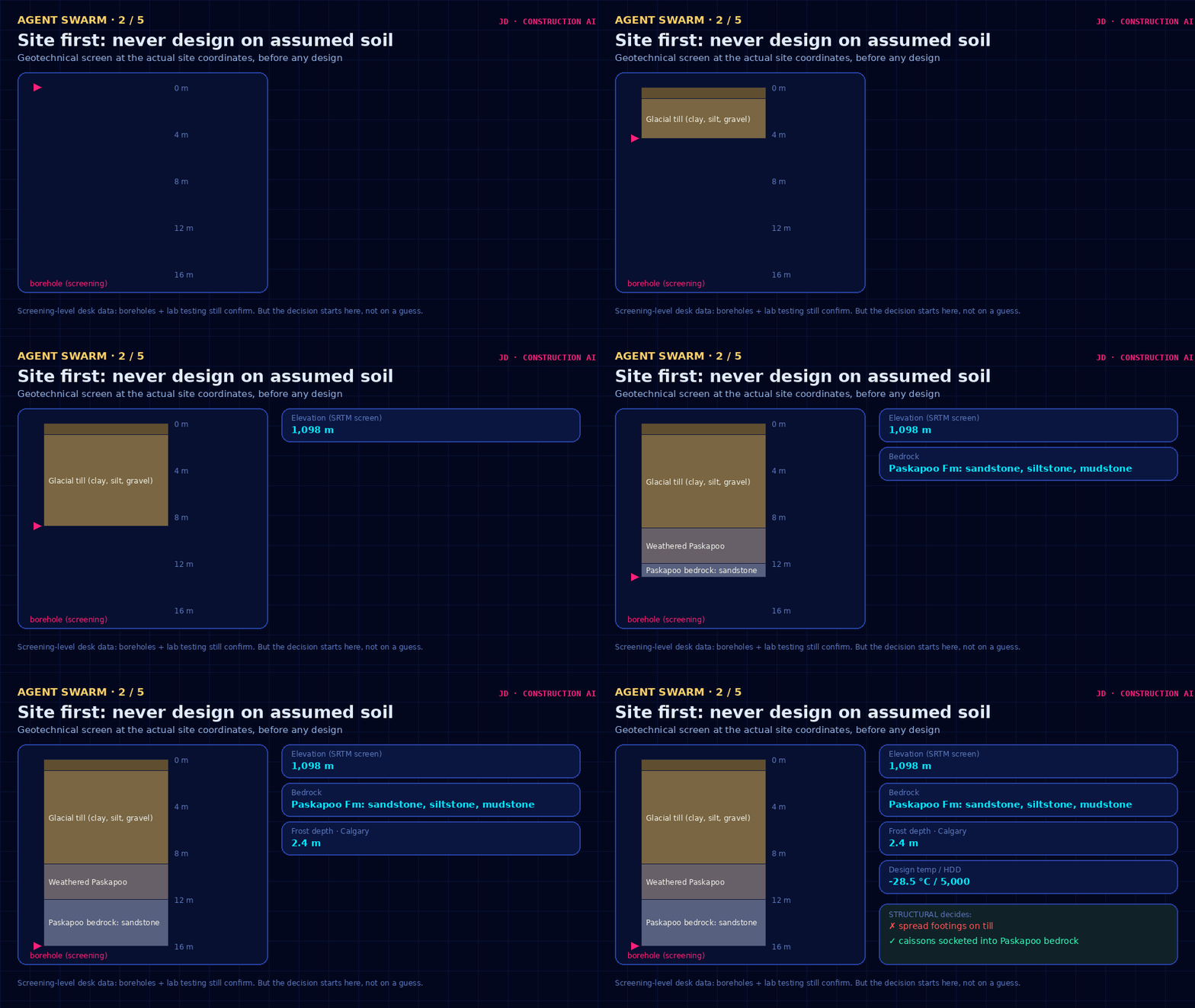
2 · Site first: geotech before design
A live geotechnical screening at the site's coordinates: 1,098 m elevation, Paskapoo Formation bedrock, 2.4 m frost penetration, −28.5 °C design temperature. Structural determinations are evidence-derived, never assumed.
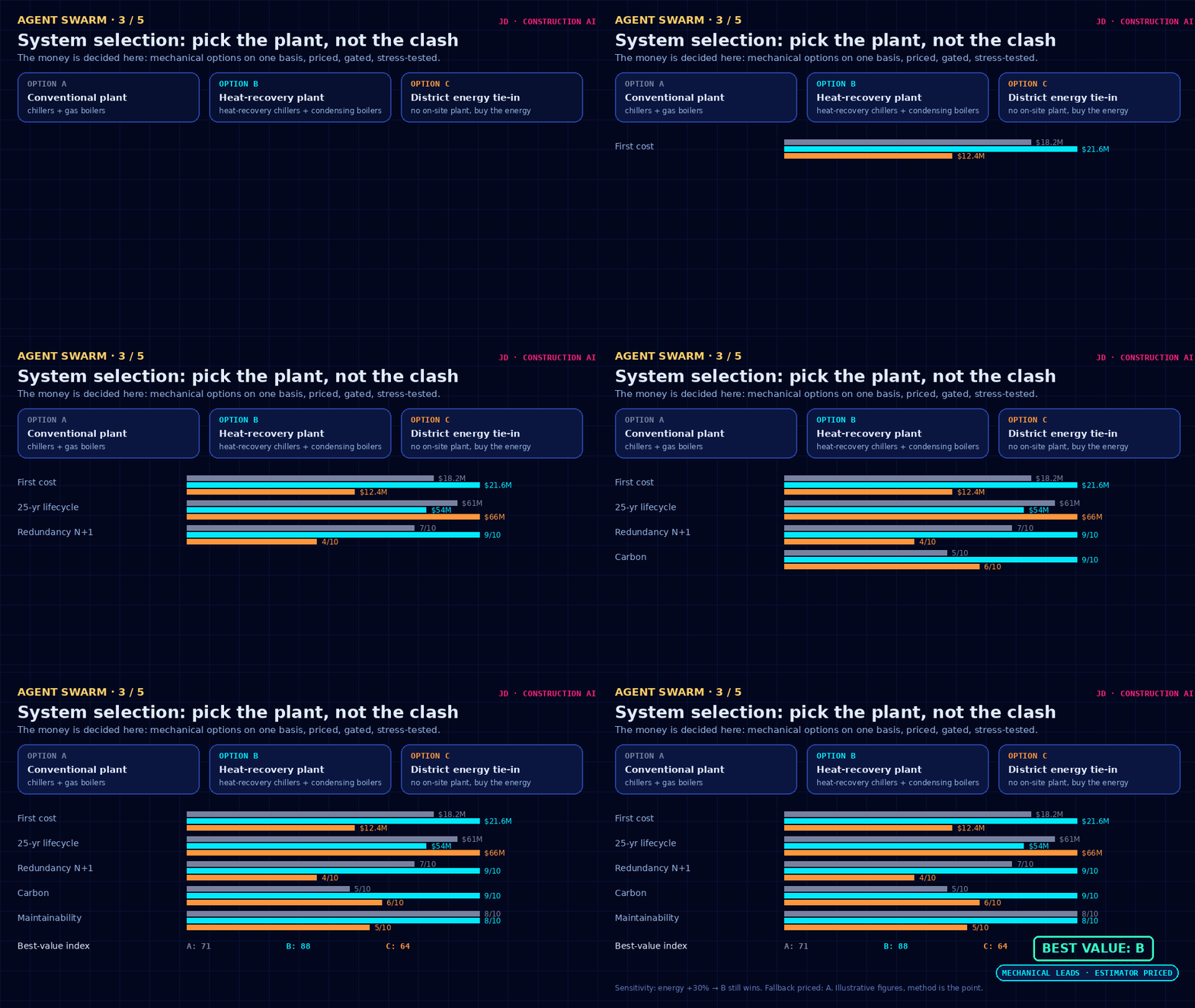
3 · System selection: pick the plant
The high-value determination is made early: which central plant serves 127,000 m² across a 25-year horizon. Mechanical leads a common-basis options evaluation (capital cost, lifecycle cost, redundancy, carbon intensity), the Estimator prices each alternative, and a sensitivity analysis stress-tests the verdict.
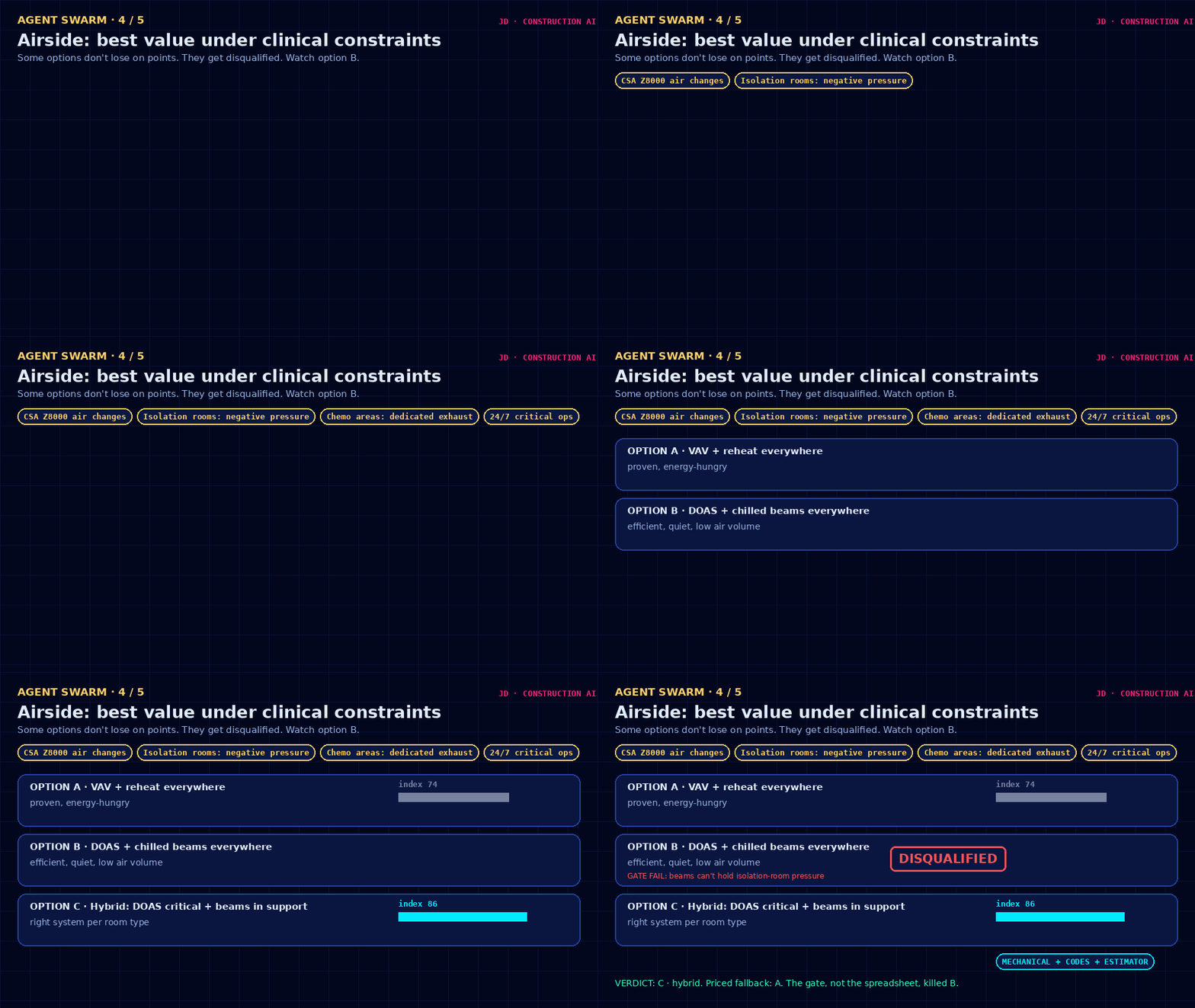
4 · Airside: best value under clinical constraints
Some alternatives are not outscored, they are disqualified: universal chilled beams fail the isolation-room pressurization gate. The hybrid prevails: dedicated outdoor air where clinical protocol mandates it, beams where it does not, with a priced contingency alternative.
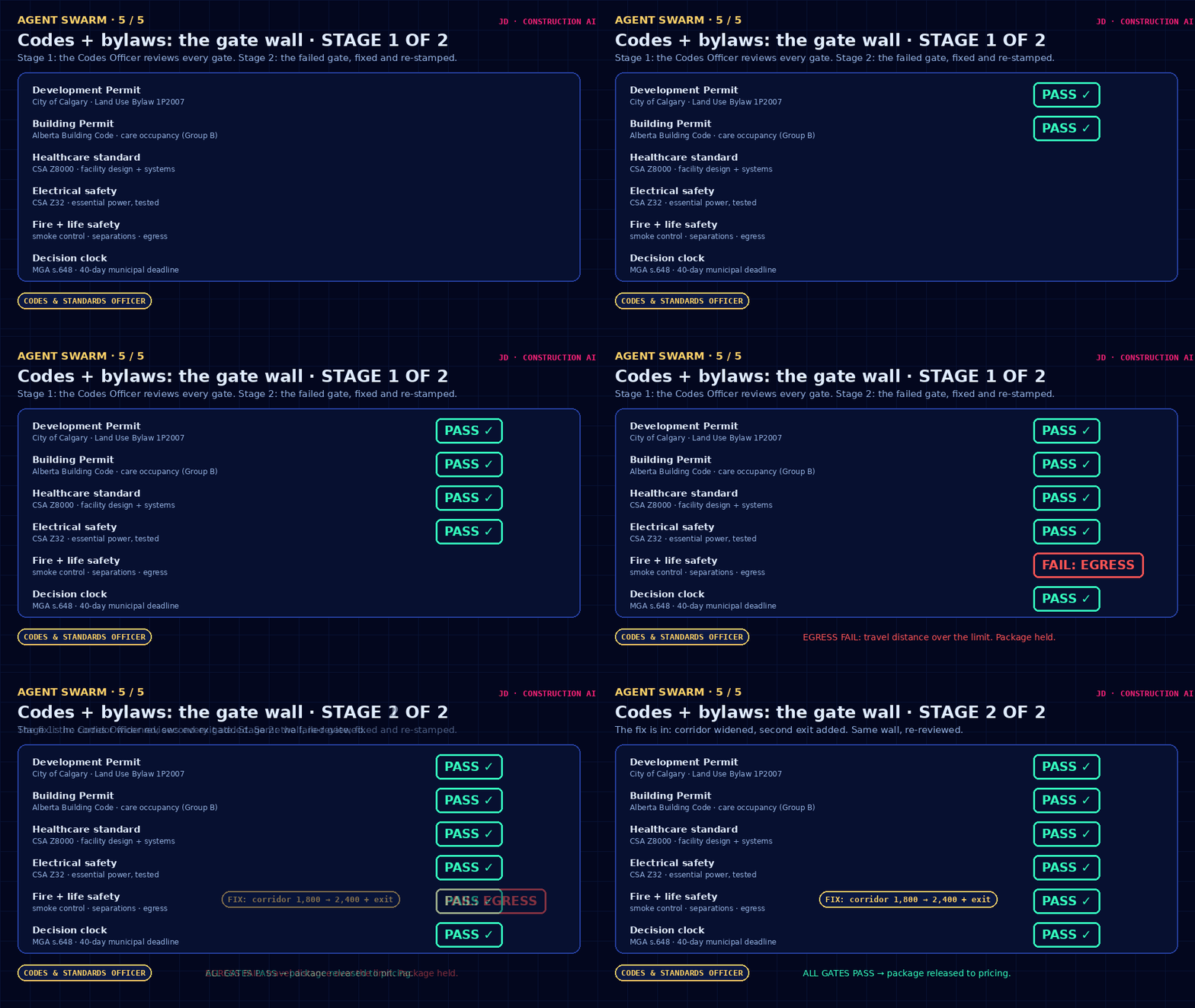
5 · Codes + bylaws: the gate wall
Two stages. Stage 1: the Codes Officer adjudicates every compliance gate, and egress fails. Stage 2: the remediation is incorporated and the wall re-adjudicates to all-pass before the package is released to pricing.
Legal + risk on the same case
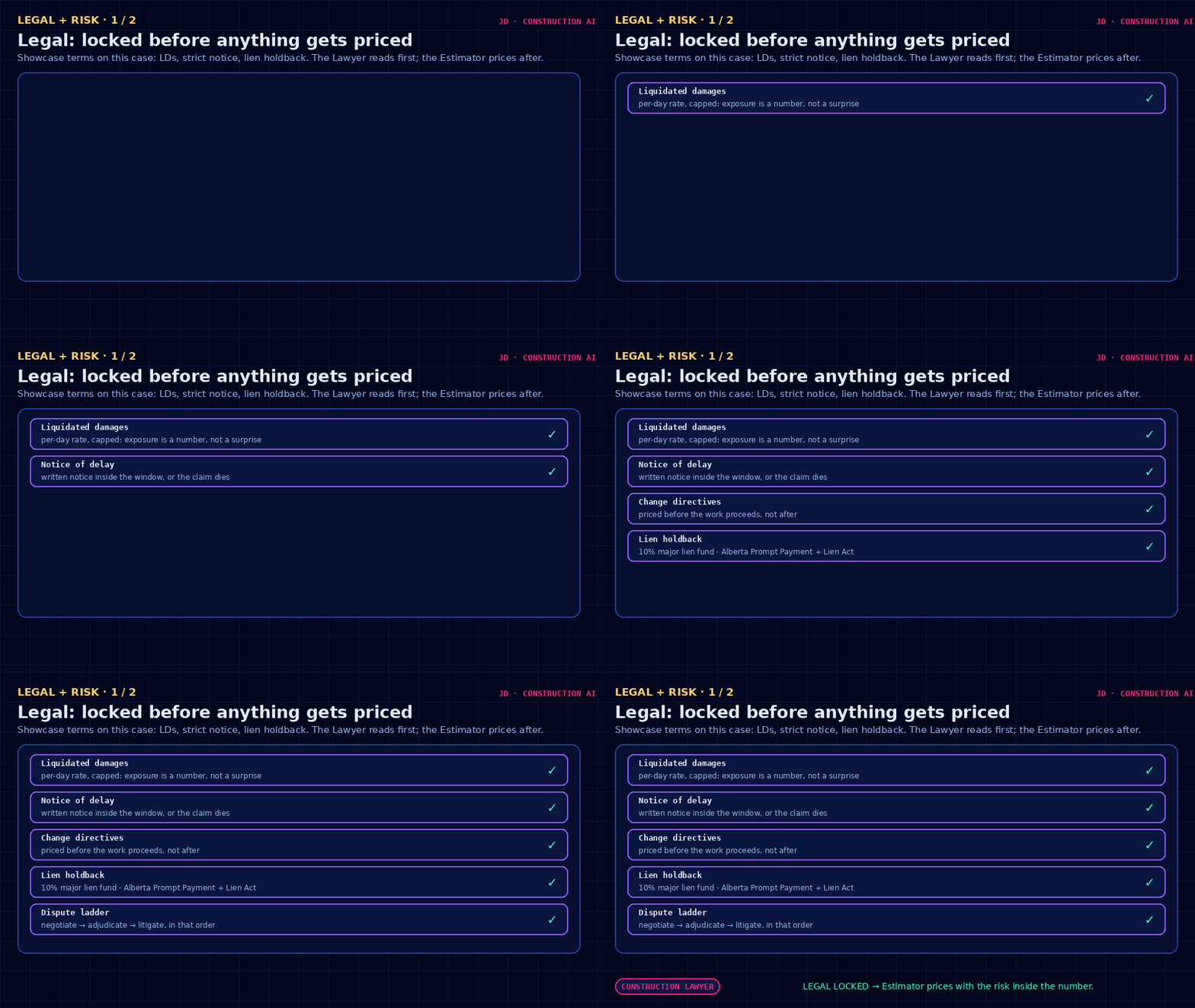
Contractual instruments modelled in full on this case: liquidated damages, strict notice regimes, statutory lien holdback, 50/50 surety bonding, builder's risk, wrap-up liability.
1 · Legal locked before pricing
The Lawyer resolves the clause stack first: liquidated-damages exposure quantified, notice windows, change-order pricing mechanics, the 10% Alberta lien holdback, the dispute-resolution ladder. Only then does the Estimator price.
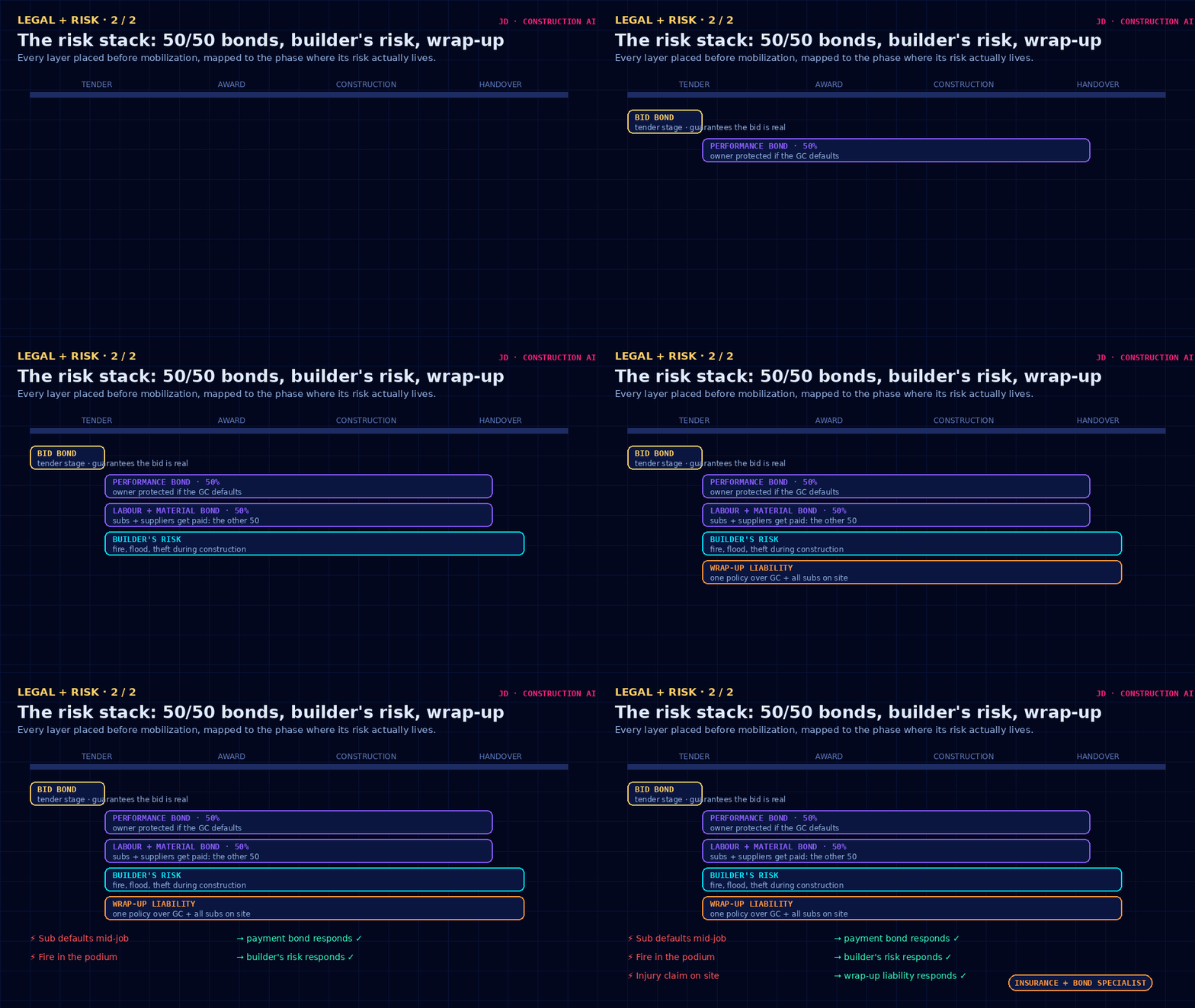
2 · The risk stack
Bid bond at tender; 50% performance and 50% labour-and-material bonds at award; builder's risk and wrap-up liability through construction. Each instrument mapped to the risk stratum it occupies, and to the response mechanism when it triggers.
How a Level 4 schedule gets built
Five stages, project brief to deliverable, inside one pipeline. Steps 1–4 build an illustrative school (3-storey K-9, 8,200 m², Calgary). Step 5 freezes that network as ground truth and issues the Level 4 package.
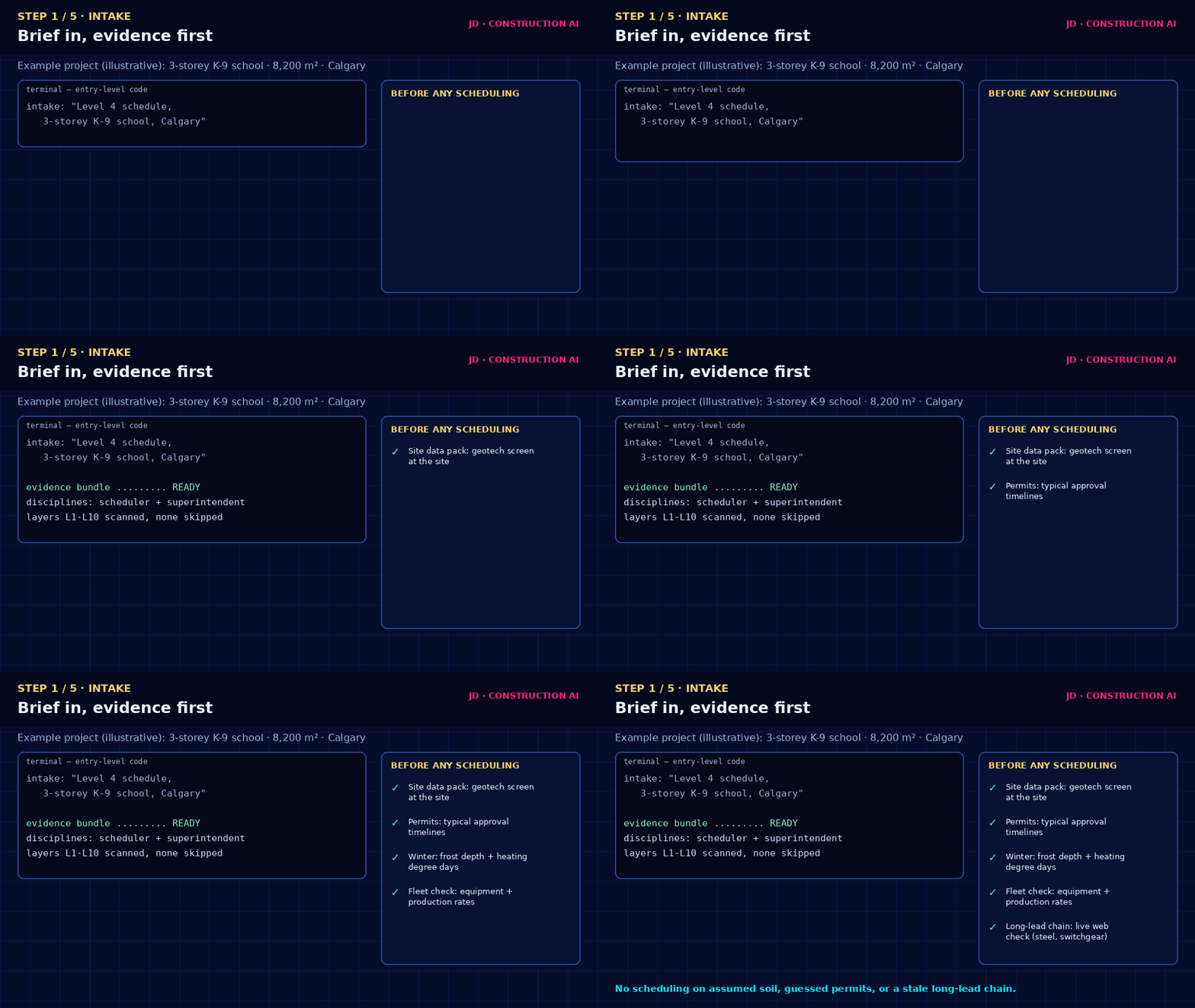
Step 1 · Intake: brief in, evidence first
A decision model classifies the project brief first: schedule type, adjudicated behind a 0.90 confidence gate, the label selecting the execution playbook and the published comparable set the network is synthesized from. Sub-gate, a deterministic router adjudicates and the divergence is flagged, never suppressed. The evidence pack then assembles: geotechnical screening, permit-duration distributions, winter-severity data, fleet capability, and a live verification of the governing long-lead procurement chain. No schedule is built on assumed soil.
Step 2 · Classify + skeleton
The brief is assigned a detail tier (a rich brief earns Tier 1, full parametric detail). A network skeleton is synthesized from published programme data for the best-matching completed project of the same type and kind, scaled by size ratio. Its precedence logic is draft only: a template, not a determination.
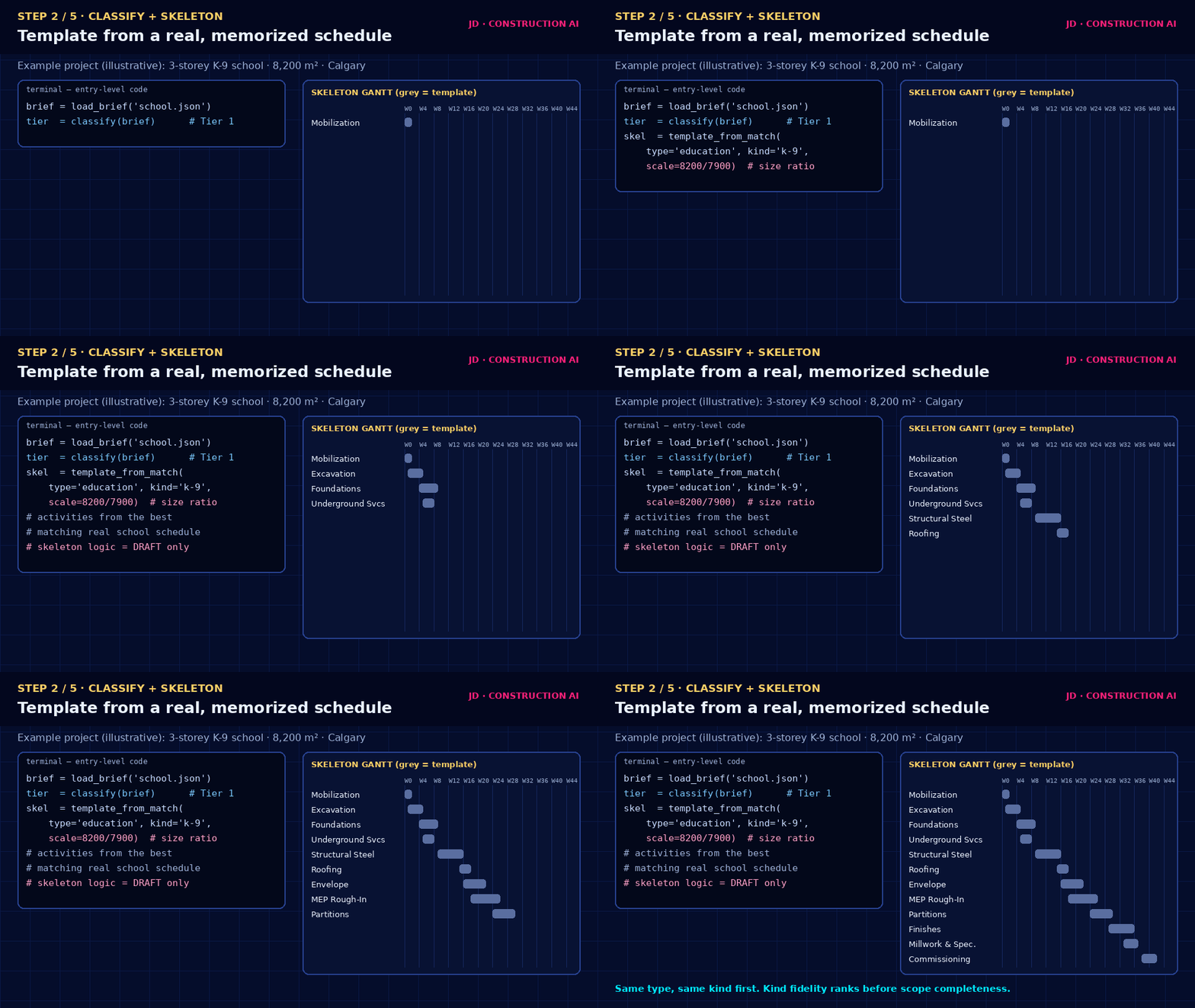
Step 3 · Superintendent: scope + quantity durations
The superintendent adapts the skeleton to the project's actual construction methodology. Durations are pure arithmetic: quantity divided by crew production rate (1,450 m³ of foundations at 290 m³/week = 5 weeks). Repetitive work is sequenced as production trains paced by the governing trade.
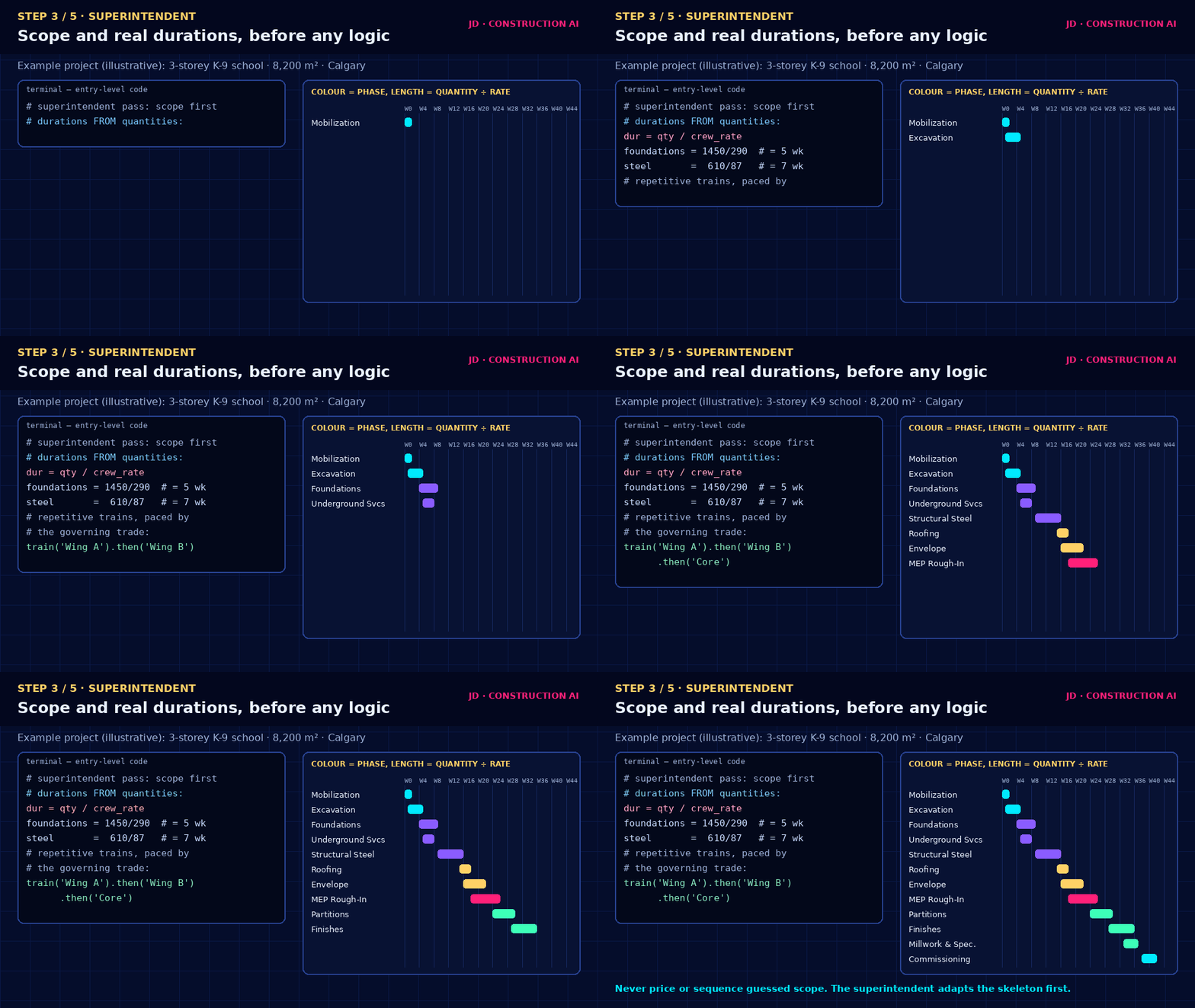
Step 4 · Scheduler: logic + CPM in code
The scheduler constructs the network deterministically: FS, SS and FF precedence relationships between activities, a forward pass computing early dates and a backward pass computing total float, all evaluated in code. Release assertions: zero dangling logic, no negative lags. Magenta denotes the critical path: float zero.
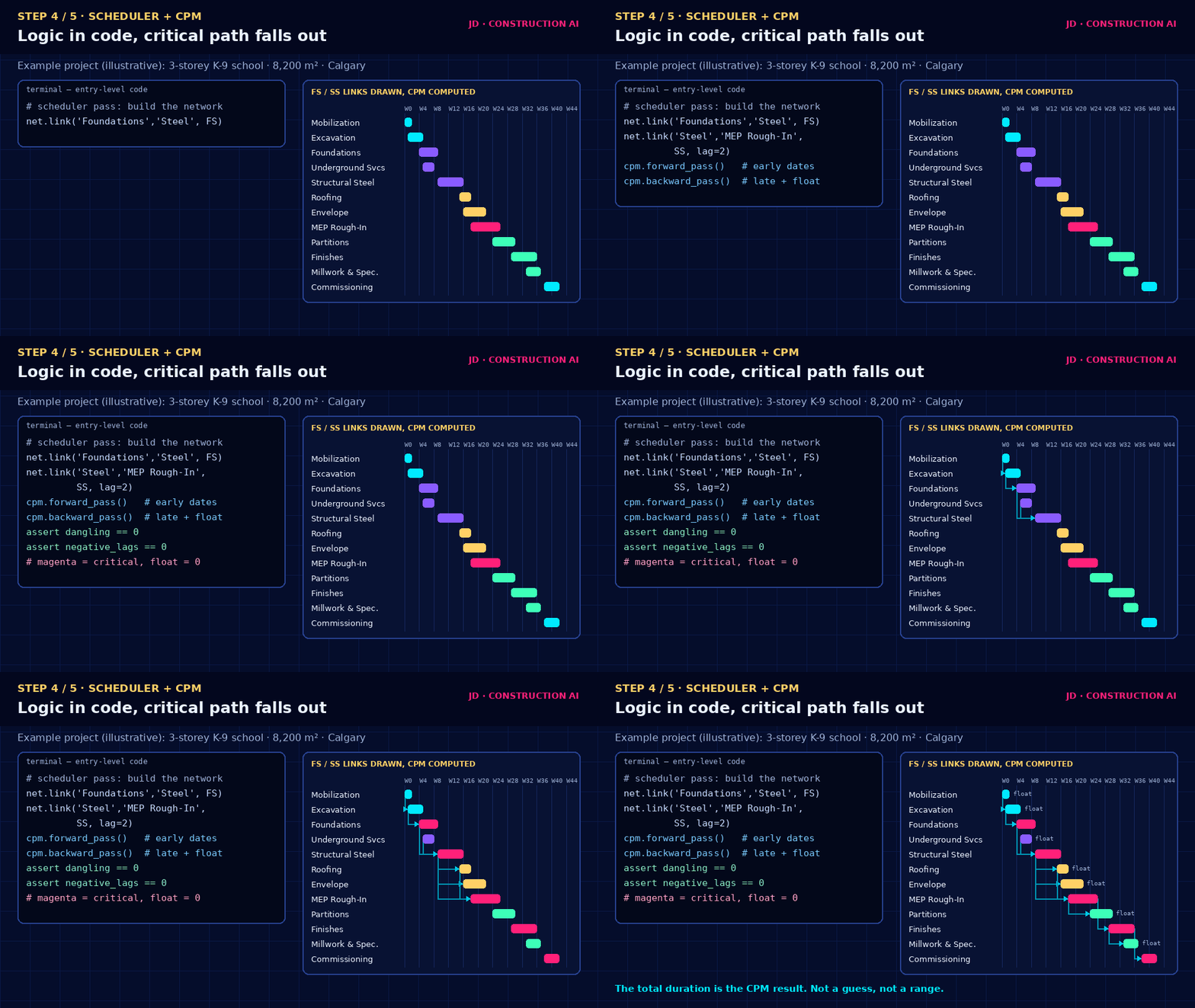
Step 5 · Freeze + deliver: the Level 4 breakout
The network is frozen as ground truth before anything is rendered. The deliverable is the same school the first four stages constructed: 186 activities at a constant time scale, paginated as the Level 4 prints (FS/SS precedence arrows throughout, critical path in magenta, contract milestones as diamonds). The total is the CPM determination of the network itself: 44 weeks, construction window. No percentile, no range: computed, not benchmarked.
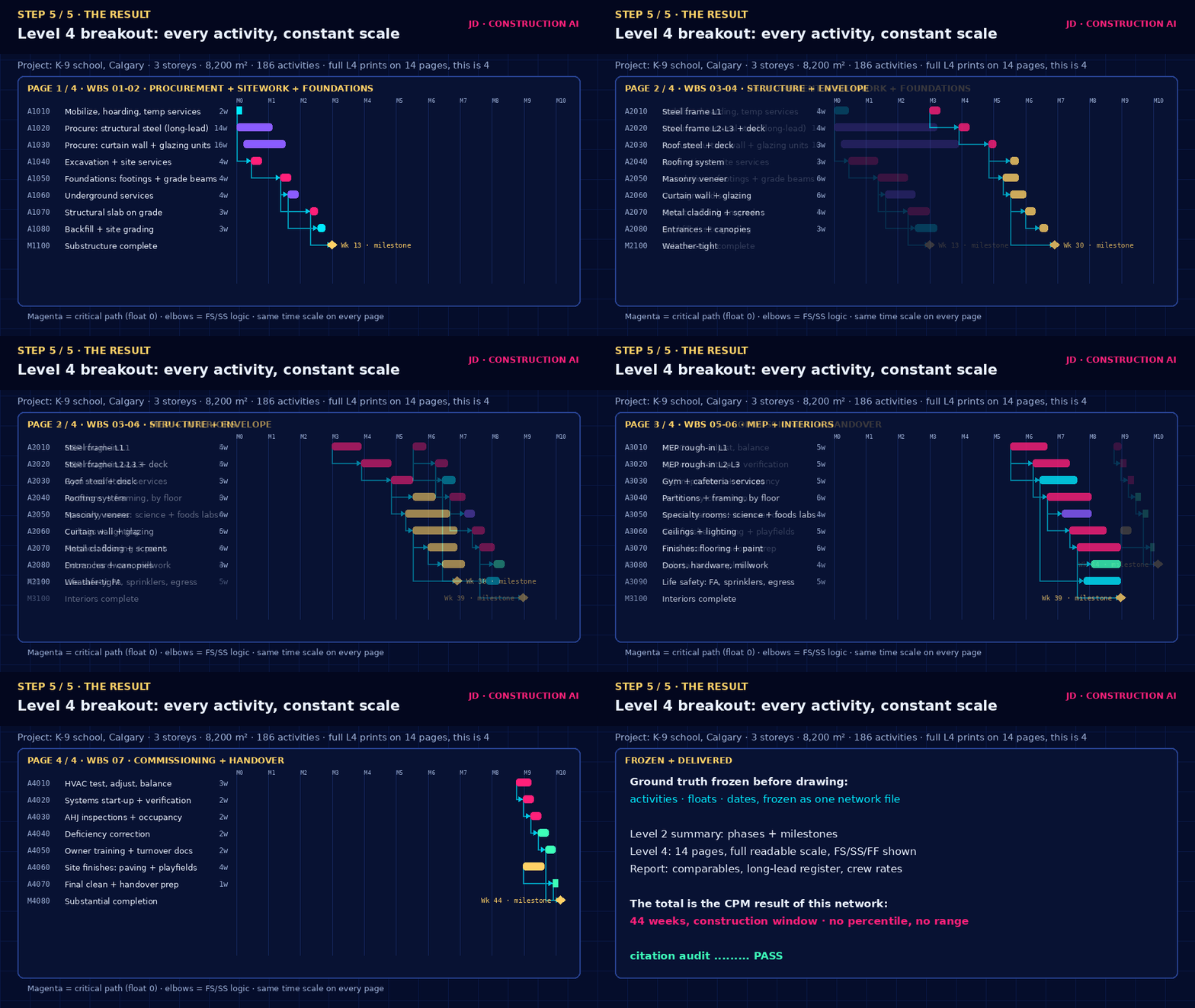
One project, four contracts
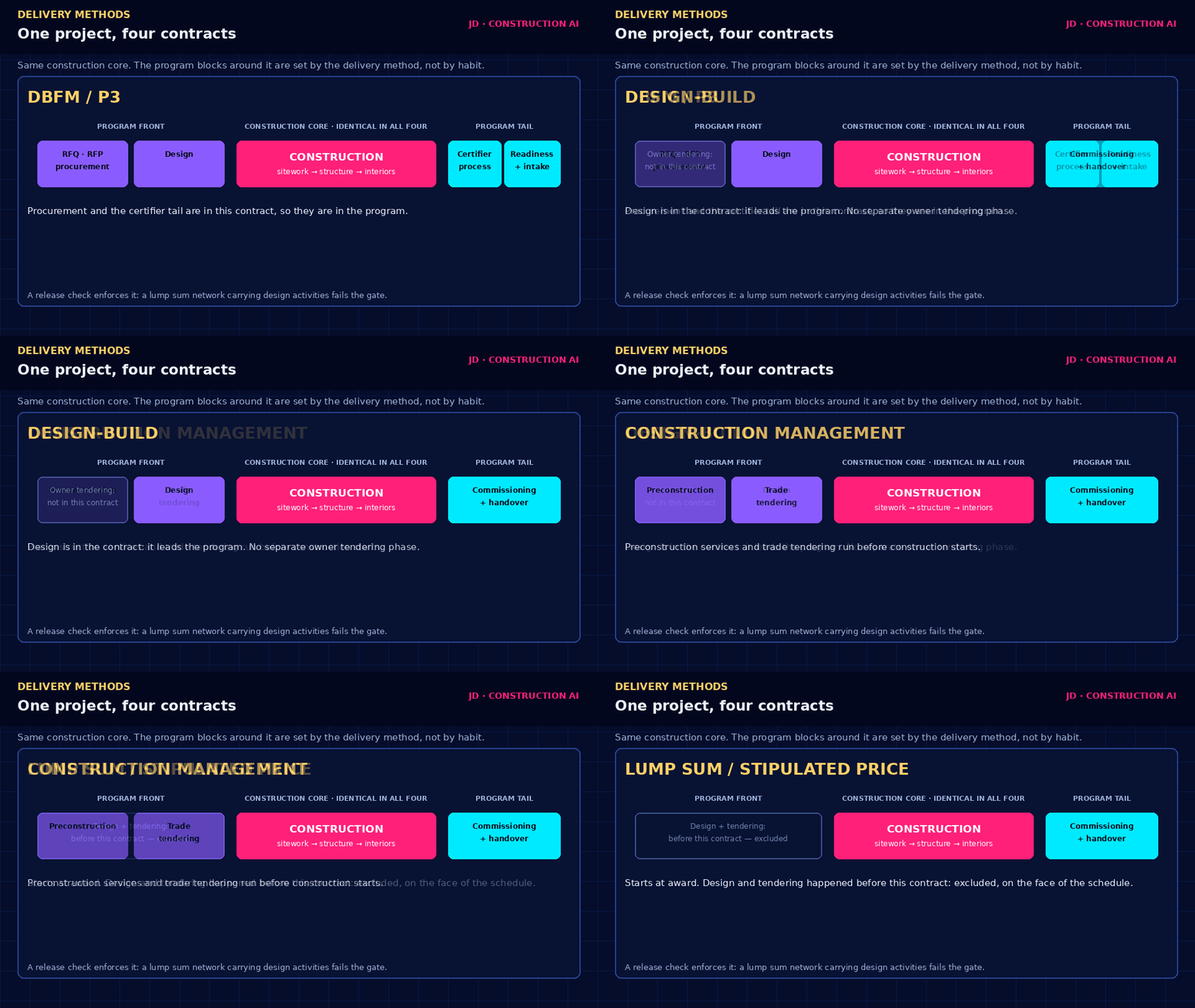
Program architecture is derived from the delivery method, never from habit. DBFM carries a procurement front-end and an Independent Certifier tail. Design-build carries the design front-end. CM carries preconstruction and trade tendering. Lump sum commences at award: construction only, the boundary declared on the face of the schedule. A release assertion enforces the correspondence before anything ships.
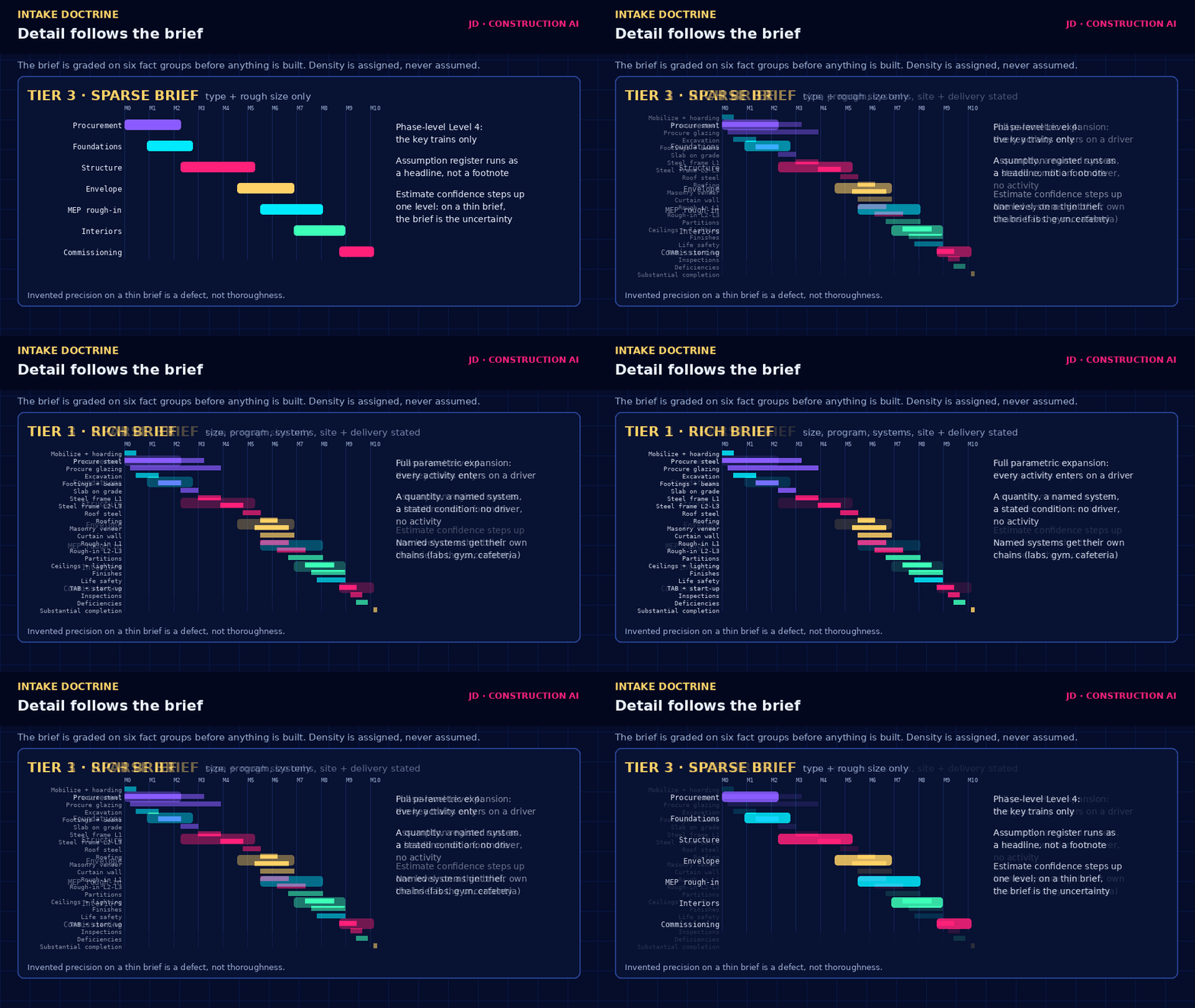
Detail follows the brief
Intake stratifies the brief across six fact groups: identity, magnitude, program, systems, site and delivery, time. A rich brief earns full parametric detail, every activity admitted on a governing driver. A sparse brief earns an honest phase-level schedule, its assumption register carried as a headline, and the estimate ascends a confidence level to price the uncertainty the brief itself introduces.
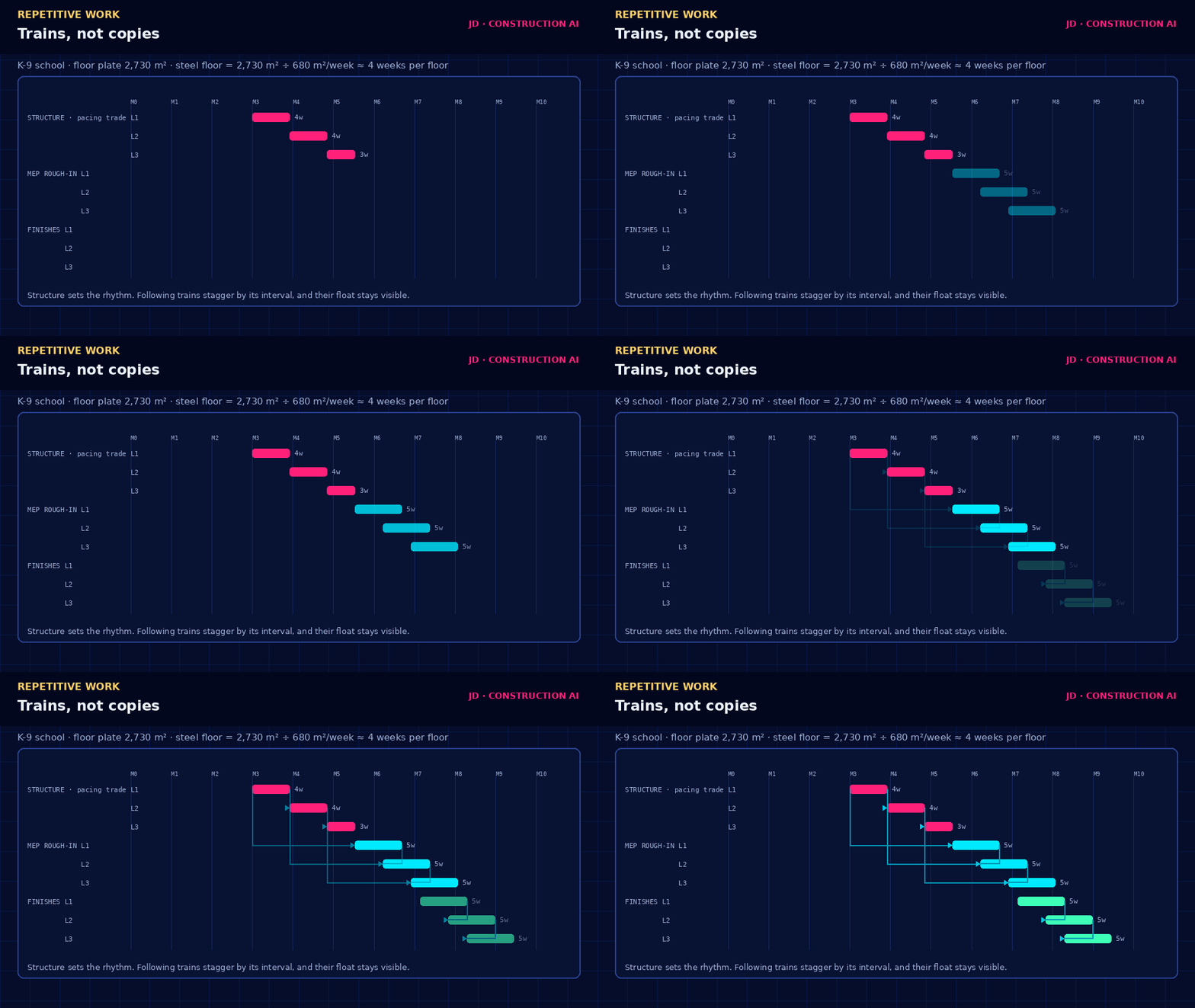
Trains, not copies
Repetitive work is never scheduled as parallel duplicates. Each unit's duration is its quantity divided by a crew production rate, and the units run as trains staggered by the pacing trade. The same rule constructed the school's floors in Step 5: structure paces, rough-in and finishes follow, their float exposed, never buried.
📦 Project Brief: Pleasant Hill Library, California
Project brief: a new public library. Program: a 650-activity Level 4 CPM network across 70 work sections, 9 contract milestones, 623 FS/SS precedence relationships, and a 140-activity driving path. Procurement and risk are controlled inside the network topology, never appended after it.
The package: basis of schedule and assumption register, Level 2 summary, the full Level 4 Gantt, long-lead procurement register, and risk controls.
Get in touch
| Base | Calgary, Alberta |
| Language | English and Vietnamese |
| [email protected] |